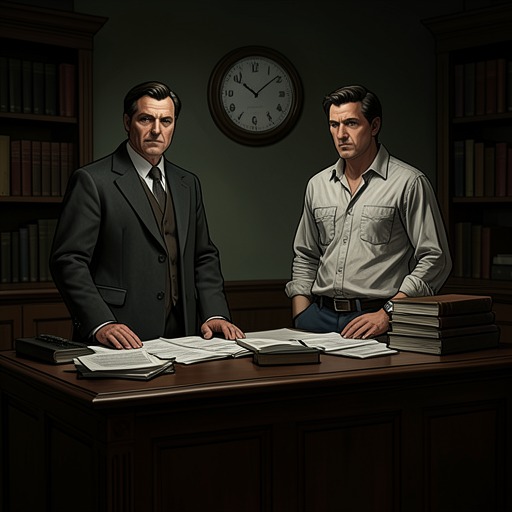
Fogg’s Journey Around the World in Eighty Days
Around the World in Eighty DaysPhileas Fogg’s Journey Around the World in Eighty Days is a wager made into a working itinerary: Fogg must return to the Reform Club in London by a precise hour, and every ship, railway, delay, and detour becomes part of the attempt. Its momentum comes not from speed alone but from the contrast between Fogg’s exact calculations and a world whose transport systems are incomplete, vulnerable, and sometimes unexpectedly helpful. The journey also changes its practical and moral stakes as Fogg’s companions and other people’s needs become part of what he must carry forward.
The wager becomes a timetable
On Wednesday, October 2, Fogg accepted his fellow club members’ challenge and set the terms with the same precision he applied to his routines. He would return to the same room at the Reform Club on Saturday, December 21, at a quarter before nine in the evening. If he failed, the twenty thousand pounds deposited in his name at Barings Bank would be theirs. He handed over a cheque for the amount, half his fortune, while anticipating that the other half might be needed to make the journey possible. The wager was therefore more than a boast: it put both a deadline and the resources for pursuing it in writing.
Fogg left the Reform Club at twenty-five minutes past seven and announced to Passepartout that they were going around the world. His departure overturned the servant’s carefully studied expectations: Passepartout had assumed that his master would not return to Saville Row until midnight. The immediate start made the abstract wager a physical undertaking, beginning with the train for Dover that Fogg intended to catch that evening.
Fogg carried a notebook that recorded actual arrivals against stipulated ones at principal points along the route, from Paris and Brindisi through Suez, Bombay, Calcutta, Singapore, Hong Kong, Yokohama, San Francisco, and New York, before the return to London. Its columns also tracked the gains and losses accumulated at each stop. At Suez, Fogg calculated that he had spent more than 158 hours travelling, or six and a half days, and recorded no gain or loss. The method made progress legible: instead of relying on a general impression of being hurried or delayed, he could tell where the journey stood against its schedule.
A route made of connections and gaps
The journey depends on a sequence of transport links, but the timetable does not make those links seamless. On the Red Sea, rough conditions sent the Mongolia rolling, silenced music and dancing, and drove passengers below deck. Fogg showed no outward anxiety about weather that might slow the ship. He seldom went on deck, ate his four meals despite the pitching, and played whist. The contrast is characteristic of the journey’s early rhythm: the sea is unsettled, while Fogg’s habits and attention to the itinerary remain steady.
At Bombay, the Mongolia arrived on October 20, two days before its scheduled arrival. Fogg entered the gain calmly in his itinerary after finishing his thirty-third game of whist. Once ashore, he prioritized errands and the passport office over the city’s sights; his regular step, described as beating like an astronomical clock, carried him past places he had no intention of visiting. These choices reveal how the wager organizes the journey. Places are primarily points of passage and calculation, not destinations for sightseeing.
India also exposes the limits of the route itself. At Kholby, the railway stopped because the line to Allahabad was unfinished; about fifty miles remained to be laid. Passengers had to find their own means of transport across the gap. Fogg had anticipated the problem and calmly proposed looking for conveyance, while Passepartout found an elephant belonging to a nearby Indian. The obstacle did not disappear through punctuality or railway planning: progress required a change of vehicle and a privately arranged passage overland.
The narrative situates this crossing in a country shaped by British rule and change. Its account distinguishes the extensive territory under the Crown from areas still outside British authority, and describes the East India Company’s earlier annexations and eventual replacement by direct Crown control. Against that political background, the travelers’ movement depends on railways, local transport, and encounters with people who can provide what the planned network does not. The itinerary records where Fogg must get next; the journey’s actual passage depends on what is available at each point.
Delay, human obligation, and chance
The stop in India brings the wager into contact with a need that cannot be reduced to a timetable. When Fogg learns that a woman is to be sacrificed at dawn, he proposes saving her and says he can devote the twelve hours he has left to the effort. This decision makes the journey more than a test of personal endurance: Fogg accepts a substantial use of time for someone in danger. After the rescue, Aouda is placed under his protection. At Allahabad, with the railway line resumed, he can still reach Calcutta in less than twenty-four hours and catch the steamer for Hong Kong scheduled to leave the next day, October 25. Passepartout receives unlimited credit to buy Aouda clothes and other necessities, turning the onward route into a responsibility to provide for a new companion as well as a race toward the next connection.
In Hong Kong, chance intervenes in the schedule. The Carnatic has to remain for boiler repairs; had it sailed as originally expected, the travelers would have missed it and faced a week’s wait for the next steamer. Fogg is nevertheless twenty-four hours behind, a delay that threatens the timetable without yet imperilling the remaining journey. Fix, the detective pursuing Fogg, decides to speak openly to Passepartout and try to detain Fogg in Hong Kong. Meanwhile, Fogg offers his arm to Aouda and searches the docks for a vessel. After three hours without finding a suitable craft, he persists, prepared to look as far as Macao. The episode sets Fix’s attempt to stop the journey against Fogg’s continued effort to find a way forward; a missed connection creates a problem, but a search for alternatives keeps the route open.
Passepartout’s own movement through the route is less secure. In Yokohama, he goes ashore alone, with no money and no clear plan beyond wandering through the streets. He finds a European quarter full of mixed crowds and feels isolated among them. His experience contrasts with Fogg’s carefully recorded itinerary: the same journey that appears as a sequence of points and times in the notebook can leave a traveler disoriented, separated from his companions, and dependent on what he can manage locally.
The American crossing and a changing balance
Across the United States, the railway itself becomes an obstacle. Near Medicine Bow, a red signal halts the train because a suspension bridge ahead is in ruinous condition, with several iron wires broken. The warning prevents the passengers from simply continuing according to schedule. It makes plain that a route printed or planned on paper cannot guarantee passage when its physical infrastructure is unsafe.
Later, the journey’s delays can be measured against a new possible connection. Fogg is told that, without the interruption caused by the Sioux raiders, he would have reached New York on the morning of the 11th, with eleven hours to spare before the steamer left. He is now twenty hours behind and must regain eight hours. Fix proposes a sail sledge as a way to recover that time. The solution depends on a different kind of movement from the railway: instead of waiting for the established system to carry them, the travelers can use a vehicle adapted to local conditions.
The sledge brings Fogg’s party to Omaha, where the Pacific Railroad ends. Omaha’s connection with Chicago runs east through the Chicago and Rock Island Railroad, which passes fifty stations. The party boards a train immediately and sees nothing of Omaha; the account makes clear that sightseeing is not their purpose. Their route continues across Iowa, over the Mississippi at Davenport, and through Illinois to Chicago. The transfer illustrates the journey’s recurring dependence on junctions: arrival at one terminus matters because another line, running in a different direction, can carry the travelers onward.
By December 16, the seventy-fifth day after leaving London, Fogg is aboard the Henrietta, and the voyage has not yet suffered a serious delay. Half the sea passage is nearly completed, but winter leaves the travelers at the mercy of the season. Passepartout secretly hopes that steam can make up for a failure of wind. When the engineer speaks earnestly with Fogg, Passepartout catches his master asking whether the news is certain. The evidence at this point makes fuel and propulsion the next threat to progress: the ship has enough coal to travel at reduced steam from New York to Bordeaux, but not enough for the full-steam passage Fogg’s schedule would require.
The journey’s governing tension
Across the recorded episodes, the wager’s decisive constraint is time, but time is never controlled by the clock alone. A railway line ends before its planned destination; a steamer’s repairs create an unexpected connection; a bridge blocks a train; wind, winter, coal, and distance shape the pace of travel. Fogg responds by recording gains and losses, accepting improvised transport, and pressing on when a conventional connection fails. The journey’s movement therefore belongs to a larger network of people, vehicles, infrastructure, and natural conditions, not solely to his will.
That network also gives the itinerary a human dimension. Fogg’s schedule first appears as a private contest backed by money, but his choice to spend twelve hours on Aouda’s rescue changes what the journey asks of him. His companions’ access to movement differs too: Passepartout can find an elephant or board a ship alone, yet can also be left without money or direction. The journey is at once a race to meet a date and a chain of encounters in which getting somewhere depends on judgment, assistance, and the willingness to respond to needs beyond the wager. The supplied episodes carry Fogg from the departure in London through India, East Asia, and the American rail network to the winter crossing aboard the Henrietta, with the promised return deadline still governing every calculation.